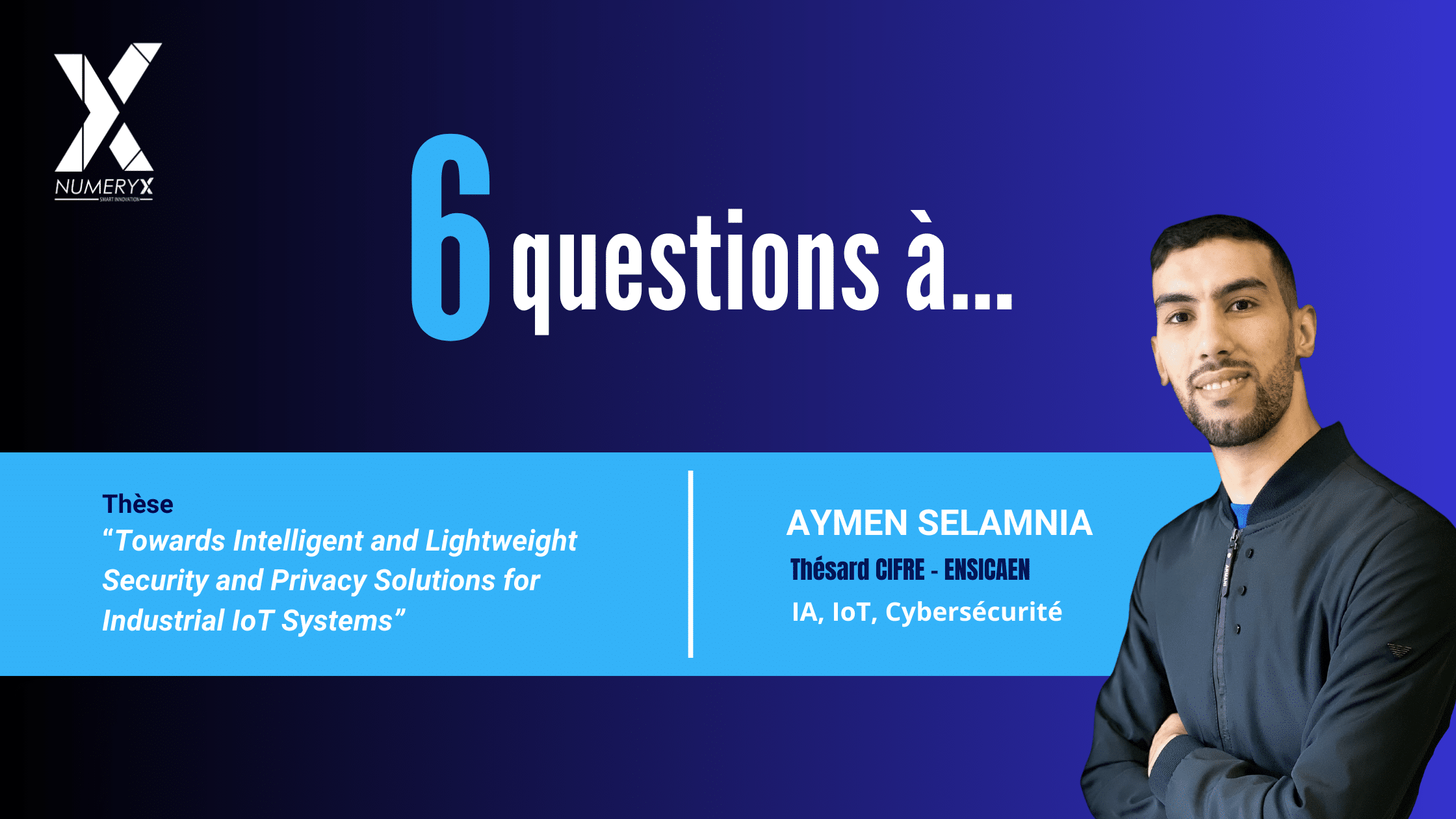
How can connected industrial objects, often deployed with no native security, be protected against ever more sophisticated threats? This is the question to which Aymen devoted several years of research in his thesis: “Towards Intelligent and Lightweight Security and Privacy Solutions for Industrial IoT Systems“. His work, at the crossroads of cybersecurity, collaborative artificial intelligence and even quantum computing, has given rise to novel solutions to strengthen the resilience of industrial systems. In this interview, he looks back on his motivations, his major contributions and his vision of the future of cybersecurity in Industry 5.0.
Q1. What motivated you to choose IIoT cybersecurity as your thesis subject, and can you give us an overview?
I chose this subject because most connected industrial objects are not designed with security in mind. These “off-the-shelf” devices are vulnerable to attacks. My work consisted in developing solutions adapted to these constrained environments, starting with lightweight defence mechanisms against DDoS attacks, then moving towards collaborative and even quantum learning approaches to anticipate future threats.
Q2. Among your four contributions (stochastic IDS, adaptive pipeline, Split Federated Learning, Quantum-SFL), which seems most promising for a concrete short-term application?
Split Federated Learning seems the most promising. It was designed from the outset to adapt to IIoT constraints: low computing power, confidentiality needs and limited communication. It can also be easily integrated into existing industrial architectures, without reinventing everything.
Q3. What were the biggest challenges you faced during your research, and how did you overcome them?
The biggest challenge was reconciling security, performance and hardware constraints. IIoT devices do not have the resources to run heavy models. I overcame this by designing hybrid architectures that distribute the intelligence between devices and servers.
Q4. How do you see cybersecurity evolving in Industry 5.0 and the role your work could play in this context?
In Industry 5.0, systems will be ultra-connected, autonomous and collaborative. Cybersecurity will have to be built in from the design stage. My work can serve as a basis for building distributed solutions that respect confidentiality and can evolve in the face of new threats, including in the quantum era.
Q5. If you had to give advice to a future cybersecurity PhD student, what would it be?
Don’t limit yourself to theory. Test in conditions close to real life and always keep in mind the balance between innovation and applicability.
Q6. How was your research influenced by the collaboration with the company (CIFRE)?
The collaboration allowed me to stay practically grounded. The company exposed me to the real constraints of industrial systems: limited budgets, low hardware resources, and the need for solutions that are quick to deploy. This steered my choices towards more pragmatic approaches, while keeping a strong scientific dimension.
Conclusion
From defence against DDoS attacks to Split Federated Learning approaches and the avenues offered by quantum, Aymen’s research is not limited to theory: it paves the way for concrete applications designed for the real constraints of industrial environments. His thesis perfectly illustrates a researcher’s ability to turn complex technological challenges into pragmatic, innovative solutions. An expertise that tomorrow could well redefine the way we design cybersecurity in the age of Industry 5.0.